Pain on the Inner Side of the Knee : Causes and Treatment
A specialist's clinical guide to identifying medial knee symptoms, distinguishing meniscus and ligament damage, and exploring non-surgical and robotic partial replacement options in Navi Mumbai.
Introduction
The timing of your symptoms provides useful clues. Pain after twisting may involve the meniscus. Pain that develops slowly and worsens while walking may indicate medial compartment osteoarthritis.
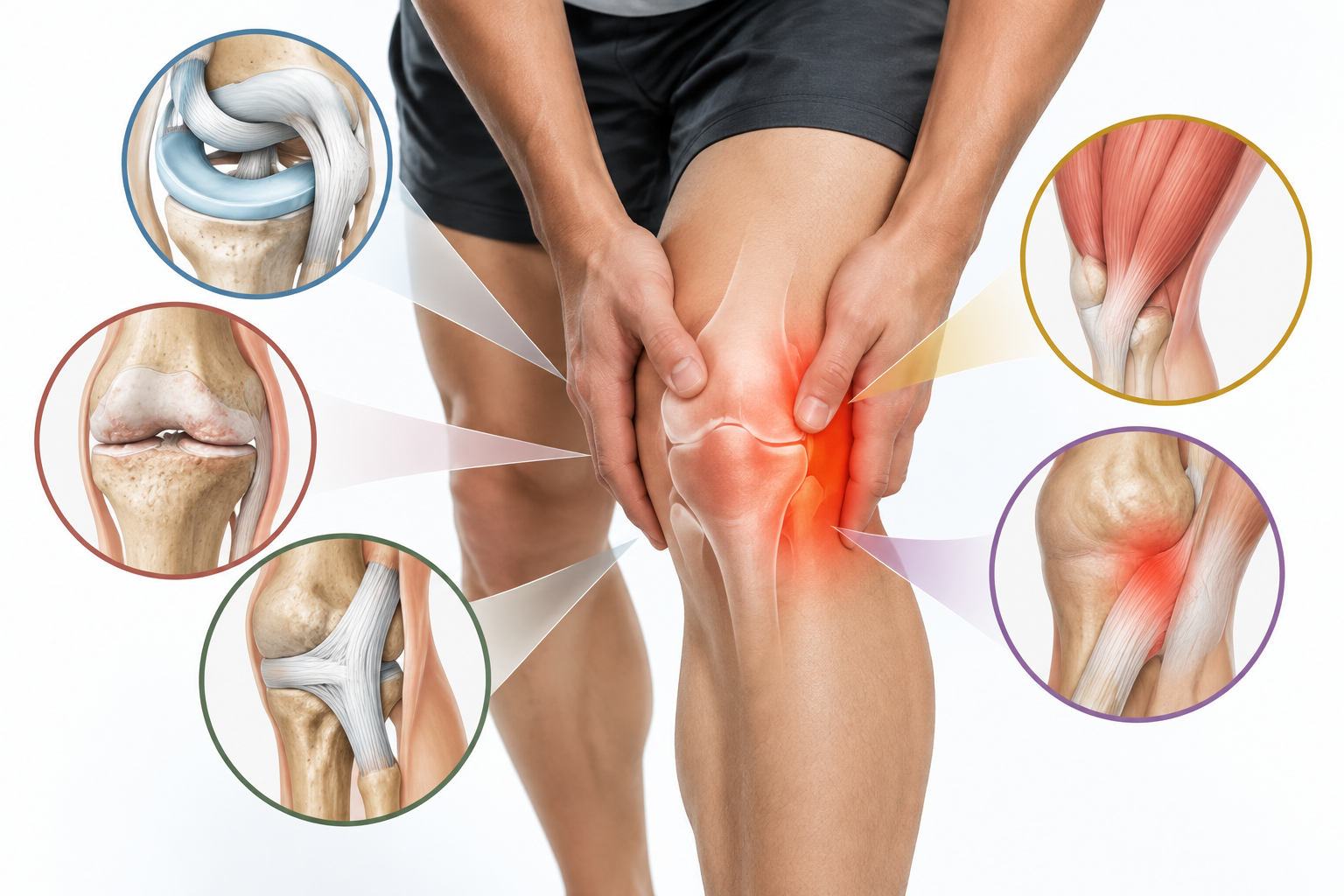
- Medial Localization: Inner knee pain is typically linked to the medial meniscus, medial collateral ligament (MCL), medial compartment osteoarthritis, or pes anserine bursitis.
- Diagnostic Precision: Pain triggers (e.g., stair climbing, twisting, morning stiffness) provide critical clues before clinical examination and imaging.
- Conservative First: Most acute injuries and early wear respond effectively to activity adjustments, targeted physiotherapy, and temporary bracing.
- Bone-Preserving Surgery: When arthritis is isolated to the inner knee compartment, Robotic Partial Knee Replacement preserves healthy bone and ligaments with faster recovery.
What Can the Location of Pain Indicate?
The precise location and trigger can help narrow down the possible cause.
| Pain pattern | Possible cause |
|---|---|
| Pain directly along the inner joint line | Medial meniscus injury or osteoarthritis |
| Pain below the inner knee joint | Pes anserine bursitis |
| Pain after an impact to the outer knee | Medial collateral ligament injury |
| Pain with clicking, catching or locking | Possible meniscus tear |
| Pain with stiffness after rest | Possible knee osteoarthritis |
| Sudden hot and swollen knee | Gout, infection or inflammatory arthritis |
These patterns provide clues but cannot replace an orthopaedic examination.
Common Causes of Inner Knee Pain
Medial Compartment Osteoarthritis
The medial compartment is the section on the inner side of your knee. Osteoarthritis develops when the cartilage covering the joint surfaces starts wearing away.
You may notice pain while walking, morning stiffness, swelling or difficulty climbing stairs. The knee may also become bow-legged as the condition progresses. When arthritis remains limited to this compartment, Partial Knee Replacement Mumbai may be considered if non-surgical treatments no longer control the symptoms.
Medial Meniscus Tear
The medial meniscus is a C-shaped piece of cartilage that cushions the knee. It can tear during a twisting movement or weaken gradually with age.
Symptoms may include joint-line pain, swelling, clicking and knee locking. Treatment depends on the tear pattern, its location and whether symptoms continue after rehabilitation.
Medial Collateral Ligament Injury
The medial collateral ligament supports the inner knee. A blow to the outer knee can stretch or tear it. The injury may cause pain, swelling and instability.
Mild injuries often improve with activity restriction, bracing and physiotherapy. More serious injuries require an orthopaedic assessment.
Pes Anserine Bursitis
Pes anserine bursitis causes pain a few centimetres below the inner knee joint. Repeated stair climbing, running, tight muscles, excess body weight and arthritis can irritate the bursa. Pain often increases during exercise or while rising from a chair.
Other possible causes include gout, inflammatory arthritis, stress fractures and pain referred from the hip.
When Should You Consult an Orthopaedic Doctor?
Book an assessment if your pain keeps returning, lasts longer than a few days or restricts normal movement.
These symptoms do not always indicate surgery. They show that your knee needs a proper diagnosis.
How Is Inner Knee Pain Diagnosed?
Your doctor will ask when the pain started, what triggered it and which activities make it worse. The examination may include:
- Checking the exact area of tenderness
- Measuring knee bending and straightening
- Testing ligament stability
- Assessing the meniscus
- Observing your walking pattern and leg alignment
Weight-bearing X-rays can show joint-space loss, bone spurs and other signs of arthritis. An MRI may be recommended when a meniscus, ligament or soft-tissue injury is suspected. You do not need an MRI for every type of knee pain.
A Partial Knee Replacement surgeon in Navi Mumbai will also check whether arthritis affects one compartment or several parts of the knee. This finding influences the treatment plan.
Treatment Options Based on the Cause
Treatment should address the source of pain rather than the symptom alone.
Activity Changes
Temporarily reduce activities that trigger pain, such as deep squats, running, twisting sports or repeated stair climbing. Complete bed rest can increase stiffness and weaken the muscles supporting your knee.
Physiotherapy
Targeted exercises can strengthen your thigh and hip muscles, improve flexibility and reduce pressure on the painful area. The exercise plan should match your diagnosis.
Medicines and Injections
Your doctor may recommend pain medicines based on your symptoms and medical history. Selected patients may benefit from a joint injection. An injection may reduce pain but cannot rebuild severely damaged cartilage.
Condition-Specific Care
An MCL sprain may require a brace and rehabilitation. Pes anserine bursitis often improves with load modification, stretching and physiotherapy. A symptomatic meniscus tear may need arthroscopic treatment if suitable non-surgical care fails.
When Is Partial Knee Replacement Considered?
It is not a treatment for every type of inner knee pain. It may suit patients with advanced osteoarthritis limited to the medial compartment, preserved ligaments and usable knee movement.
During Partial Knee Replacement surgery in Kharghar, Mumbai, the surgeon replaces only the damaged joint surfaces while preserving healthy areas of the knee. The decision depends on X-rays, physical examination, knee alignment and your response to non-surgical treatment.
Patients exploring robotic Partial Knee Replacement in Navi Mumbai should know that robotic technology supports surgical planning and implant positioning. The surgeon still evaluates the knee, controls the procedure and makes each clinical decision. An evaluation with a Partial Knee Replacement Surgeon in Mumbai can help determine whether your arthritis is limited enough for this procedure.
Consultation for Inner Knee Pain in Kharghar
Dr. Pramod Bhor, MS Orthopaedics, evaluates knee arthritis, meniscus injuries, ligament problems and persistent inner knee pain in Kharghar. Patients receive an assessment at Kharghar Medicity Hospital, Sector 7, or Medicover Hospital, Sector 10, Kharghar, Navi Mumbai.
Frequently Asked Questions
Common questions and expert answers regarding medial knee pain and treatment:
Take the Next Step Towards Pain-Free Movement
Inner knee pain can arise from cartilage wear, a meniscus tear, ligament damage or bursitis. The right treatment depends on the underlying condition and not only on where you feel pain. Early evaluation can protect your movement and prevent unnecessary treatment. If your symptoms continue, consult an orthopaedic surgeon in Navi Mumbai.